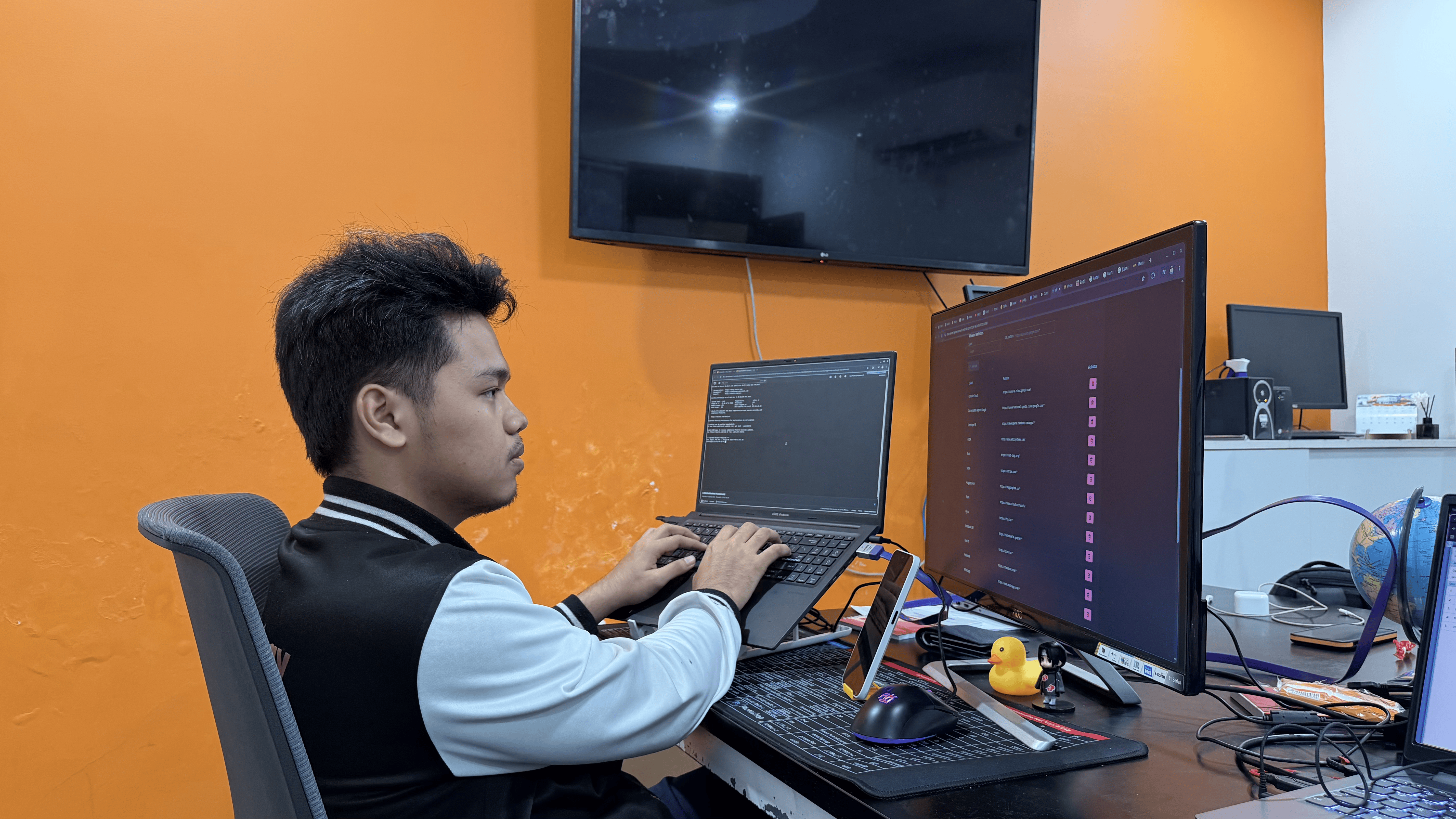
Zarni Hlawn at his desk
Zarni Hlawn.
Software Engineer & Architect

MSc Computer Science

Back to Academic

University of Wolverhampton · October 2025 – Present

Program

MSc Computer Science at the University of Wolverhampton — a BCS-accredited postgraduate degree that builds specialised, applied expertise for industry and research. The curriculum emphasises practical experience alongside theory taught by active researchers, across full-time (typically 12 months) or part-time routes.


Focus

  1. Advanced Artificial Intelligence and Machine Learning
  2. Data Science and Data Mining
  3. Immersive Application Development (VR, AR, and mixed reality)
  4. Mobile Application Development
  5. Web Technologies
  6. Research Methods in Computing
  7. ITM and Computer Science Dissertation

Applications

Five systems built for modules and research during the MSc. Titles open the public repository.


Portfolio Journal

Sole developer

Offline-first Flutter journal for the Mobile Application Development portfolio.

Overview

Portfolio Journal is an Android-oriented Flutter client built for the 7CC012 Mobile Application Development brief. It keeps a personal journal fully usable offline: notes live in SQLite on the device, images are copied into app documents, and sharing goes through the system share sheet rather than a custom social backend.

Capabilities

  • Create, edit, view, and delete notes (optional title, required body)
  • Home feed of messages with detail screens and search
  • Swipe-to-delete and long-press multi-select for batch deletion
  • Attach photos from gallery or camera; persist under app storage
  • Share text and optional image via Android ACTION_SEND
  • Connectivity banner when offline — the app remains fully usable

Stack

Flutter (Material 3) · sqflite for local persistence · image_picker, share_plus, connectivity_plus, flutter_slidable, flutter_animate


Drive

Sole developer

Personal Storage-as-a-Service — files, teams, sharing, and pluggable storage backends.

Overview

Drive (ZNL-DRIVE) is a SvelteKit file workspace with Postgres metadata and bytes on Local filesystem or Tigris object storage. It covers the product surface of a small cloud drive: Home library, Shared, Trash, team drives, public links, chunked uploads, and a REST API usable with session cookies or developer API keys.

Capabilities

  • Browse folders with breadcrumbs, color labels, pin, and star
  • Upload (including chunked large files) and download files or folder ZIPs
  • Share with signed-in users; Shared view is read-oriented
  • Team drives with a fixed storage provider per team
  • Revocable public share tokens for anonymous preview/download
  • Trash with restore / permanent delete and scheduled purge
  • Better Auth (email/password + optional GitHub/Google OAuth)

Stack

SvelteKit 2 + Svelte 5, Tailwind CSS 4, daisyUI 5 · Postgres (Neon) + Drizzle ORM, Better Auth · Local filesystem and Tigris S3-compatible storage · Docker / Fly.io deployment


Escape from Kidnappers in Abandoned House

Lead software developer

Unity 3D VR escape experience — Team CoreX assignment; lead software developer.

Overview

A Unity VR game where the player wakes as a captive in an abandoned building and must gather clues, tools, and power to escape. Built with Team CoreX for a group assignment, using Unity 2022 LTS and room-scale style interaction (grab, flashlight, keypad, fuse/power puzzles).

Role & delivery

  • Led software development across core gameplay systems
  • Collaborated with UX/UI, project management, and QA teammates
  • Interaction design for VR grab, tool use, radio, flashlight, and puzzle props

Stack

Unity 2022.3 LTS · C# · VR interaction and scene scripting


AdaDDAE (ADBench)

Research & implementation

Master’s thesis implementation — adaptive diffusion-scheduled anomaly detection on tabular data.

Overview

AdaDDAE extends diffusion-scheduled denoising autoencoders for tabular anomaly detection, evaluated on ADBench (57 datasets). The repository is organized as a named-component framework — each piece (noise schedule, sampling, scoring, ablations) has a clear role so experiments and contribution waterfalls stay reproducible on CPU and GPU profiles.

Research themes

  • Leak-safe feature tuning (PCA / scaler pipeline)
  • Dataset-adaptive and manifold-aligned noise scheduling
  • SNR-stratified timestep selection and contrastive pair sampling
  • Variance-uncertainty and diffusion-time posterior scoring views
  • Ablation ladders and hardware profiles (CPU through 8–16 GB GPUs)

Stack

Python, PyTorch-oriented training scripts · ADBench datasets and YAML experiment configs · CPU and Vast.ai GPU run profiles


Clinical IR App

Developer

Streamlit dashboard comparing clinical retrieval systems on MIMIC-IV discharge notes.

Overview

A Streamlit evaluation app for clinical information retrieval. On a shared random sample of MIMIC-IV discharge notes it compares three retrieval stacks — sparse lexical, dense semantic, and a hybrid medical pipeline — with live search, note detail, and a graded 10-query evaluation panel (Precision@3, Recall@3, MAP, NDCG@3). For research use only; not for clinical decision-making.

Systems compared

  • System A — TF-IDF + cosine similarity (lexical baseline)
  • System B — dense semantic search with all-MiniLM-L6-v2
  • System C — hybrid BM25 + MedCPT dual encoders fused with Reciprocal Rank Fusion (RRF)

Stack

Python + Streamlit · MIMIC-IV / MIMIC-IV-Note (PhysioNet credentialed access) · Hugging Face embedding / MedCPT models · IEEE-format portfolio report (LaTeX)

enmyja